RPE vs RIR: which should you use for hypertrophy training?

RPE and RIR are both effort scales. Most lifters use them interchangeably, swapping “RPE 8” and “2 RIR” as if they’re the same thing. They aren’t, and if you’re training for hypertrophy the distinction matters more than you’d think.
This isn’t a beginner’s guide to either system. If you’re reading this you probably already log an effort number against your sets, whether that’s in a notebook or in RESISTX’s workout logging. The question is whether you’re using the right scale for the job.
A quick refresher
RPE (rate of perceived exertion)
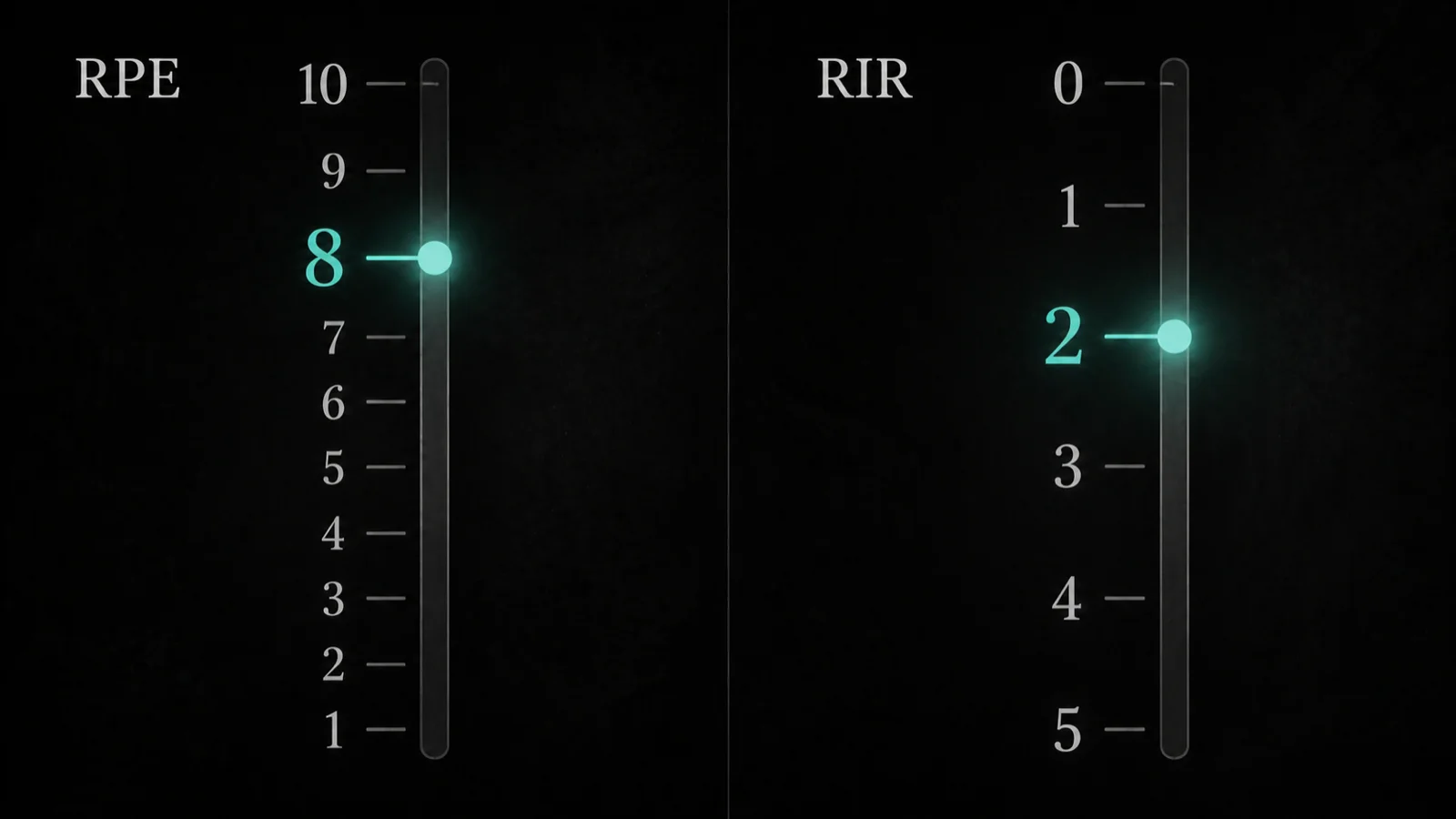
Originally developed by Gunnar Borg as a 6-20 scale for cardiovascular effort, RPE was adapted into a 1-10 scale for resistance training by powerlifter Mike Tuchscherer. In this context RPE 10 means absolute failure: you could not have completed another rep. RPE 9 means you had 1 rep left, RPE 8 means 2 reps left, and so on.
The key word is perceived. RPE is subjective by design. It captures how many reps you had in reserve, and it also captures how hard the set felt: grind quality, accumulated fatigue, psychological state, everything that shapes your experience of effort.
RIR (reps in reserve)
RIR is simpler. It’s a direct estimate of how many additional reps you could have completed with acceptable form. RIR 2 means you could have done 2 more. RIR 0 means failure.
There’s no perception component built in. It’s meant to be an objective estimate of remaining capacity on that specific set.
If RPE 8 equals RIR 2, what’s the difference?
On paper RPE 8 and RIR 2 describe the same set, and numerically they map onto each other cleanly: RPE = 10 minus RIR. The difference is what each number asks you to pay attention to, and that changes how you think about your training.
RPE captures more information. When you report an RPE of 8 you’re implicitly accounting for things RIR doesn’t touch. Was the bar speed slow? Were you grinding? Did you feel strong or flat? RPE absorbs all of that. A pair of sets can both be 2 reps from failure and feel completely different, and RPE reflects that difference where RIR doesn’t.
RIR is more actionable. “Do 3 sets of 10 at RIR 2” is a clear instruction: pick a weight, do your reps, stop when you think you’ve got 2 left. There’s less ambiguity than “do 3 sets of 10 at RPE 8”, even though both theoretically prescribe the same thing, because RPE invites you to factor in how you feel, which makes it harder to standardise across sessions.
Lifters are worse at estimating than they think. Research from Helms et al. (2016) showed that trained lifters are reasonably accurate at estimating RIR when they’re close to failure (0-3 RIR), but accuracy drops significantly beyond that. At 4+ RIR most people are guessing. Any effort-based prescription loses reliability at lower intensities, whichever scale it’s written in. Every training number carries an error bar you should know before you act on it, which is why the DEXA scan error bars are worth reading alongside this one.
What does this mean for hypertrophy?
Hypertrophy training lives in a specific intensity window. The current evidence suggests that most muscle growth comes from reps performed in the roughly 1-5 RIR range, what some coaches call “effective reps” or “stimulating reps”. Go too far from failure and you’re accumulating junk volume. Go to failure too often and you’re generating excessive fatigue without proportional gains.
This creates a practical problem: you need to land your sets in a fairly narrow band of proximity to failure, and you need a reliable way to gauge where you are. Proximity to failure is also only half of the dose. The other half is how many sets per muscle you do each week, the territory of MEV, MAV and MRV, and a set logged at 5 RIR inflates that count without contributing much to it.
Use RIR for prescribing intensity
When you’re writing a program, or following one, RIR is the better tool for prescribing how hard each set should be. It’s specific and it translates cleanly into action.
A program that says “Week 1: 3x10 at RIR 3, Week 2: 3x10 at RIR 2, Week 3: 3x10 at RIR 1” gives you a clear progression of effort across a mesocycle. You know exactly what’s expected, and you can adjust load accordingly.
RPE works here too, but the subjectivity introduces noise. Different lifters, or the same lifter on different days, might interpret “RPE 7” quite differently. RIR, being a concrete number of reps, is harder to fudge (though not impossible).
Use RPE for autoregulation
This is where RPE earns its keep. Autoregulation means adjusting your training in real time based on how you’re performing on a given day, and RPE is purpose-built for it.
Say your program calls for 3x10 at RIR 2, and you hit your first set with a weight you’ve used before. Today it felt like RPE 9: technically still 1 RIR, but the grind was ugly, bar speed was slow, and you felt shaky at lockout. RIR alone would tell you “close enough, maybe drop a rep”. RPE tells you something more useful: this session isn’t going well, and you should probably reduce load or volume.
The slow bar speed is the one part of that feeling you can measure directly. RESISTX’s rep-quality analysis reads rep-speed falloff within a set from the phone camera, on any exercise, so the “it felt slow” component of an RPE 9 has a number sitting next to it.
Autoregulating on RPE is especially valuable during deload weeks, high-stress periods, or when you’re accumulating fatigue across a training block. RPE gives you permission to back off when the numbers say you should push, because it accounts for the full picture rather than a rep count alone.
The accuracy problem at higher rep ranges
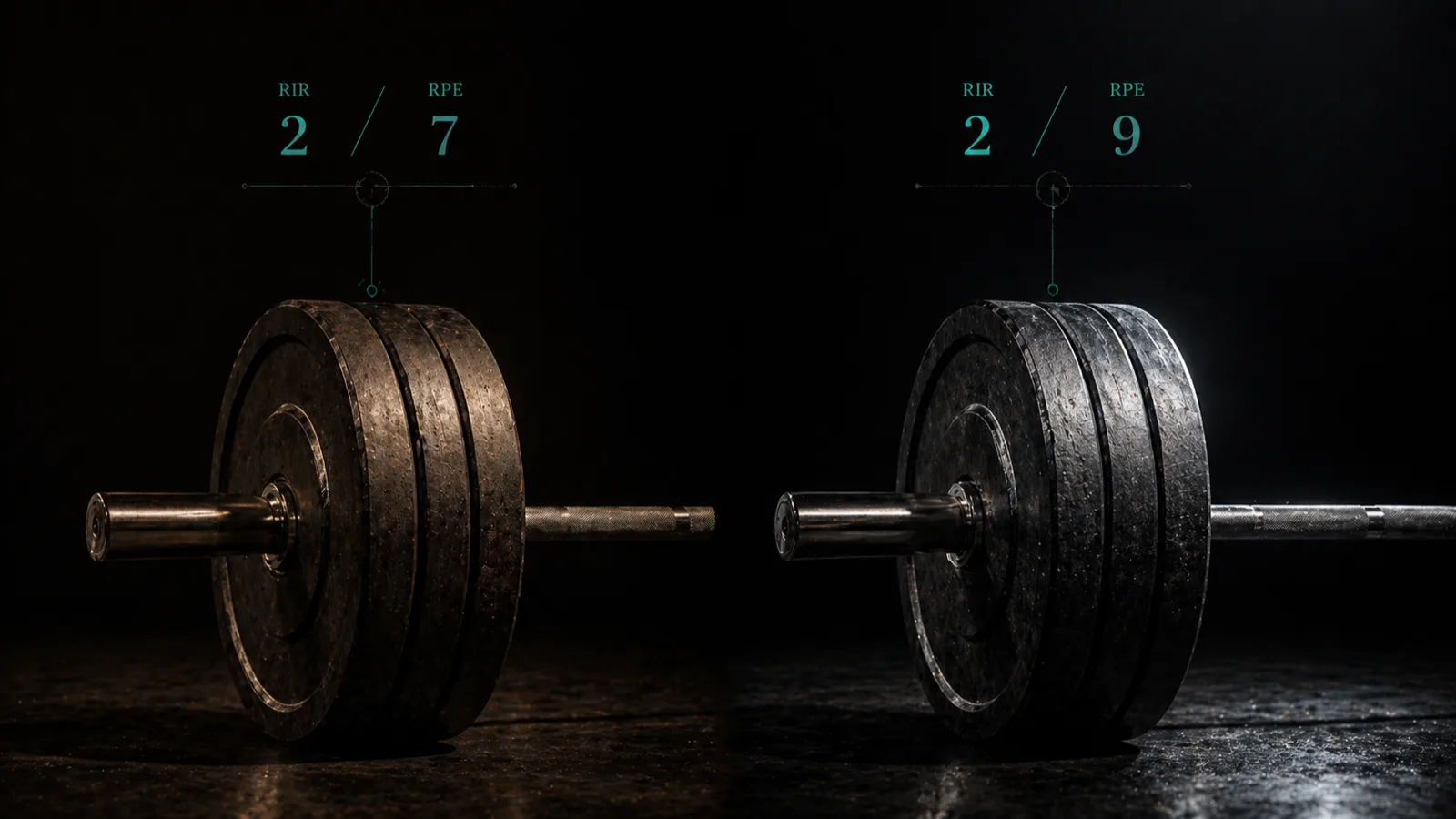
There’s another wrinkle that matters for hypertrophy specifically. A lot of hypertrophy work happens in the 10-20 rep range, and this is precisely where RIR estimation falls apart. When you’re doing a set of 15 on lateral raises, can you honestly say whether you had 2 or 4 reps left? Probably not.
For isolation work and higher-rep compounds you might be better off with a simpler effort classification: easy, moderate, hard, very hard, failure. This maps roughly to RPE ranges and avoids the false precision of claiming “RIR 2” on a set of 20 leg extensions. The same logic applies to counting indirect volume when compounds are involved: a rough number you can reproduce beats a precise one you can’t.
RPE vs RIR: a practical comparison
| Factor | RPE | RIR |
|---|---|---|
| What it measures | Subjective effort perception | Estimated reps remaining |
| Best for | Autoregulation, session-level decisions | Prescribing intensity, programming |
| Accounts for fatigue and mood | Yes, inherently | No, by design |
| Accuracy at high reps (10+) | Moderate, captures overall effort | Poor, estimation breaks down |
| Accuracy near failure (0-3) | Good | Good |
| Programming clarity | Less precise | More precise |
| Learning curve | Moderate, needs calibration | Low, intuitive concept |
| Useful for tracking trends | Yes, flags fatigue and readiness | Yes, tracks proximity to failure |
Should you use both?
Yes, and that isn’t a cop-out answer. RPE and RIR do different jobs, and using both gives you the most complete picture of your training stimulus.
Program with RIR. Set your target intensities in RIR terms. “3 sets of 8-12 at RIR 2” is clear, repeatable and easy to progress. When you hit the top of your rep range at the prescribed RIR, add weight.
Autoregulate with RPE. After each set, note how it felt. If your RIR 2 sets are consistently feeling like RPE 9.5, slow and grinding and ugly, that’s a signal. Maybe you need a deload, maybe you’re under-recovered, or maybe your RIR estimate is off and you’re closer to failure than you think. To tell those apart, check the signs you need a deload week in your log: load and reps at a matched RIR falling across two or three sessions is the version of that feeling you can actually verify.
Log both. Over time the relationship between your RPE and your RIR tells a story. When RPE is consistently higher than the RIR would suggest (you report RIR 2 but it felt like RPE 9.5), you’re probably accumulating more fatigue than your program accounts for. When RPE runs lower than expected, you’re fresh and could push harder. Single sets are noisy the same way single weigh-ins are, which is the logic behind how weight smoothing works: one reading means little, the run of them means plenty.
If you are also dieting, review the nutrition record alongside the training log. Checking your intake against your back-calculated expenditure gives you another part of the picture before changing the program.
This dual logging is where a proper tracking tool matters. Scribbling “RPE 8, RIR 2” in the notes field of a generic workout app isn’t the same as having a structured field on every set that you can read back over weeks and months. The popular loggers do capture the number, which is why hevy vs strong turns out to be a smaller question than what either of them does with it afterwards. RESISTX records load, reps, RIR and RPE against every set for exactly that reason: the effort number sits next to the performance it describes, where the pattern can be seen.
Two limits to keep in mind while you do this. Neither scale is accurate beyond about 3 reps from failure, so a target of RIR 4 or RPE 6 is a guess dressed up as a number, and both fall apart on high-rep isolation work. Log what you can defend: an RIR you’d stake money on for the heavy compounds, an RPE or a plain “hard” or “very hard” for the 20-rep leg extensions, and the same convention every session so the trend means something. The same self-report limit shows up on the nutrition side, which is why adaptive TDEE for lifters works off your weight trend instead of taking the logged calories at face value.