MEV, MAV and MRV: a practical guide to volume landmarks

You’ve read the RP articles and you can probably recite the definitions from memory. But when it comes time to program your training, you’re guessing. Here’s how to stop.
Volume landmarks are as useful a framework as evidence-based hypertrophy training has produced, and almost every article about them stops at the theory. They’ll give you a tidy diagram with 3 neat lines on a dose-response curve, then leave you to work out where you sit on it. For a framework that’s supposed to be individualised, that’s a bit of a joke.
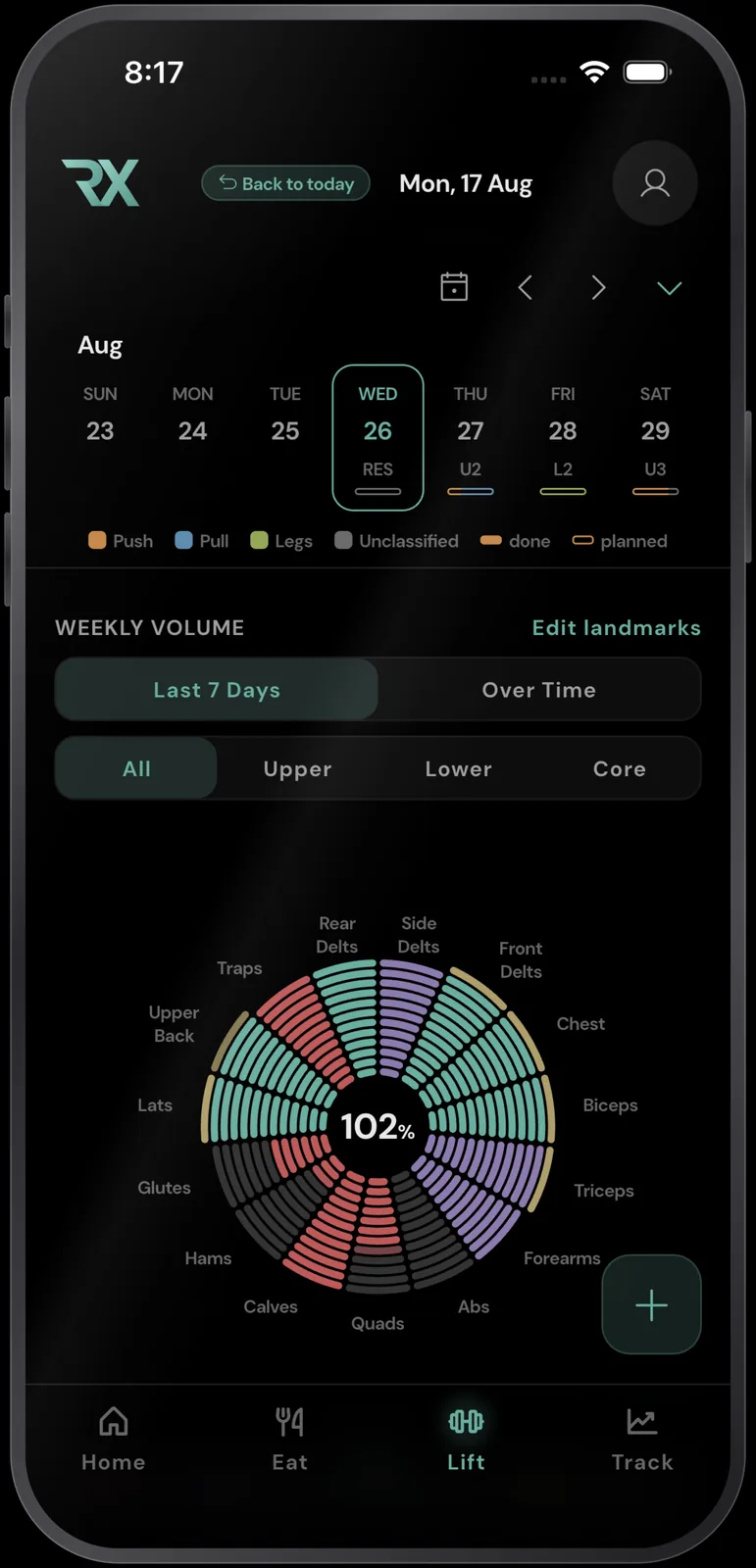
This is the practical guide: how to find your own landmarks, how to structure mesocycles around them, and how to track them as they shift. It’s also the thinking behind the volume landmarks screen in the training side of RESISTX, which scores weekly sets per muscle against MEV, MAV and MRV zones.
The quick definitions
You probably know these, but for clarity:
- MEV (minimum effective volume): the lowest volume that produces measurable hypertrophy. Below this you’re maintaining at best.
- MAV (maximum adaptive volume): the volume range where you get the best gains relative to recovery cost. The sweet spot.
- MRV (maximum recoverable volume): the highest volume you can handle and still recover from before the next session. Beyond this you’re accumulating fatigue faster than you can clear it.
There’s also MV (maintenance volume), which sits below MEV: the minimum needed to not lose muscle. Useful for deload phases and specialisation blocks where you need to pull volume from non-priority groups.
Simple enough on paper. The hard part is that these numbers are different for every lifter, every muscle group and every phase of training.
Why can’t you just look them up?
You’ll find plenty of tables online giving “average” volume landmarks by muscle group, something like “MEV for quads is 8 sets, MAV is 12-18, MRV is 20+”. Those numbers aren’t wrong as rough population averages, but they’re about as useful as saying the average shoe size is 10.
Your personal landmarks depend on:
- Training age. A lifter with 10 years of consistent training will have a higher MEV and MRV than someone with 2.
- Recovery capacity. Sleep quality, nutrition, stress, age and PED use all shift your landmarks up or down.
- Exercise selection. 10 sets of hack squats tax recovery differently from 10 sets of leg extensions, even if both “count” as quad volume.
- Muscle group. Side delts can handle far more volume than lower back. Your landmarks will vary dramatically across body parts.
- Current phase. Your MRV at the start of a mesocycle is higher than your MRV 5 weeks in, because fatigue is cumulative.
So you need to find your own, and you need to keep finding them, because they change.
How do you find your MEV?
Your MEV is the minimum dose that moves the needle. Here’s how to identify it.
Start a mesocycle at a conservative volume. For most intermediate-to-advanced lifters, something like 6-8 hard sets per muscle group per week is a reasonable starting point. A hard set here means one taken close to failure, logged as an RIR or an RPE (which effort scale to use is its own question). If you’re coming off a deload this should feel easy; that’s the point.
Now pay attention to 3 signals over the first 1-2 weeks:
- Strength trajectory. Are your working weights or reps trending up, even slightly? That’s a sign you’re above MEV.
- Pump quality. Subjective, but consistent. Are you getting a decent pump and feeling the target muscle work? If the stimulus feels trivial, you might be below MEV.
- Soreness patterns. Some degree of novel soreness (especially early in a meso) suggests the muscle is receiving a meaningful stimulus. Zero soreness combined with zero performance change suggests you’re below the threshold.
If you’re progressing on all 3 fronts at your starting volume, you’ve found (or you’re above) your MEV. If you’re stagnant, bump volume by 1-2 sets per week and reassess.
MEV is not fixed across a training career. As you get more advanced it tends to creep up: what gave you gains as an intermediate might only maintain you as an advanced lifter. That’s diminishing returns, and there’s no way around it.
How do you find your MRV?
MRV is easier to identify than MEV, because your body tells you when you’ve crossed it. The signals are louder; you just have to be honest about reading them. If the run-down feeling persists for weeks after a deload, that’s the point where a panel is worth pulling, and the guide to blood test markers for lifters covers which ones actually shift under hard training.
Warning signs you’re at or beyond MRV:
- Performance regression. Weights going down or reps dropping despite trying hard. The single most reliable indicator.
- Excessive, lingering soreness. You’re still sore from Monday’s session when Thursday’s rolls around. Properly impaired, well past “a bit tight”.
- Sleep disruption. High training stress elevates cortisol. If you’re suddenly sleeping poorly mid-meso, volume might be the culprit.
- Motivation cratering. A persistent dread of training that wasn’t there 2 weeks ago, which is a different thing from the ordinary “I don’t feel like it today”.
- Joint aches. Connective tissue can’t recover as fast as muscle. New, nagging joint pain is a volume red flag.
- Systemic fatigue. Feeling run down outside the gym. Getting sick. These are signs your total recovery demand is exceeding supply.
You want to approach MRV, not live there. The goal of a mesocycle is to push close to this boundary by the final week, then deload before you cross it. The signs you need a deload week that hold up are the logged ones: load and reps at a matched RIR falling across two or three sessions, rather than how heavy the warm-ups felt. If you’re hitting MRV in week 2 of a 5-week meso, your starting volume was too high.
MAV: where you should spend most of your time
MAV is a range rather than a single number: the band between MEV and MRV where you get the best return on investment. For most lifters and most muscle groups it sits roughly in the middle-to-upper portion of your recoverable volume.
The reason MAV matters is efficiency. You could train at MRV every week and probably get slightly more growth in the short term. But the fatigue cost is enormous, your injury risk goes up, and you’ll need longer and more frequent deloads. Over a training year, the lifter who spends 80% of their time in the MAV range will almost certainly make better progress than the one who redlines every session.
MAV is the point where adding more volume would cost more in recovery than it returns in growth.
The mesocycle approach
The landmarks are most useful as a structure for a mesocycle. The basic framework:
- Week 1: start at or slightly above MEV. This should feel manageable. You’re fresh from a deload, fatigue is low, and you’re setting baselines.
- Weeks 2-3: add 1-2 sets per muscle group per week. You’re climbing through the MAV range. Performance should be trending up.
- Weeks 4-5: you’re approaching your upper MAV or tickling your MRV. Training is hard. Fatigue is accumulating. Performance gains are slowing or stalling.
- Deload week: drop back to MV (maintenance volume) or below. Let fatigue dissipate. Sensitise the muscle to stimulus again.
Then you repeat, ideally starting the next meso at a slightly higher volume than the last one started, because your fitness has improved and your landmarks have shifted up slightly.
A practical example: chest over a mesocycle
Say you’re an intermediate lifter and a few mesocycles of tracking have given you the following landmarks for chest:
| Landmark | Sets per week |
|---|---|
| MV (maintenance) | 6 |
| MEV | 10 |
| MAV | 14-18 |
| MRV | 22 |
Your 5-week mesocycle might look like this:
| Week | Chest sets | Notes |
|---|---|---|
| 1 | 10 | Starting at MEV. Flat bench 3x8, incline DB 3x10, cable fly 2x12, dip 2x10. |
| 2 | 12 | Add one set to flat bench and one to cable fly. Weights should be moving up. |
| 3 | 14 | Add another exercise or extra sets. Entering MAV range. Pump is excellent. |
| 4 | 16 | Upper MAV. Training feels hard. Soreness is higher. Strength still progressing, but slower. |
| 5 | 18 | Approaching MRV. Performance might plateau. This is the “overreaching” week. |
| Deload | 6 | Drop to MV. Half the sets, keep intensity moderate. Recover. |
Notice we never hit 22 sets (MRV). We got close enough to generate a strong stimulus while staying recoverable. Next mesocycle you might start at 12 and push to 20, if recovery and life circumstances allow it.
Common mistakes
Starting too high
If you begin a mesocycle at 16 sets for a muscle group, you have nowhere to progress to. You’ll hit MRV by week 2-3, accumulate junk volume for the rest of the block, and wonder why you’re not growing. Start lower than you think you need to.
Treating landmarks as fixed
Your MRV in January is not your MRV in July. It shifts with training status, life stress, nutrition and accumulated fitness. Re-evaluate every few mesocycles.
Ignoring per-muscle differences
Don’t apply the same volume progression to every muscle group. Your quads and your biceps have very different recovery profiles. Program them independently.
Confusing systemic and local MRV
You might be able to handle 20 sets of side delts per week in isolation. But if you’re also doing 18 sets of chest, 16 of back and 14 of quads, your systemic recovery is overloaded even if no single muscle group has hit its local MRV.
Why does this require data?
You cannot reliably find or track your volume landmarks by feel alone. Memory is unreliable, perception of effort is biased by mood, sleep and caffeine, and the changes happen gradually enough that you won’t notice the pattern unless you’re logging it. The same caution applies to any measurement you use to judge whether the volume is working: a body-fat method comparison shows how large each method’s error bar is before a change counts as real. Daily scale weight has the same problem, which is the whole point of trend weight vs scale weight: the noise in a single reading is several times larger than the real change underneath it. Food intake is the same problem in a different app, and a macrofactor vs cronometer comparison mostly comes down to which one you’ll still be logging in by week 5, because underfeeding a mesocycle drags your MRV down with it.
Calorie estimates need the same scrutiny as training records. Before adjusting intake, check the food log and the weight trend that produced the estimate; adaptive TDEE explained covers that calculation and its limitations.
What you need to track, at minimum:
- Weekly sets per muscle group. Sets that count as effective volume for the target muscle, which is a different number from total sets once compounds are involved; how to count sets per muscle covers the half-credit rule.
- Performance metrics. Weight, reps and RPE or RIR for your key movements. This is your primary signal for whether volume is productive or excessive.
- Recovery markers. Soreness, sleep quality, motivation. Even rough subjective scores (1-5 scale) become useful over time.
When you correlate these across multiple mesocycles, patterns emerge. You’ll see that your bench press performance peaks around 14-16 chest sets and declines above 20. You’ll notice that your side delts keep responding up to 25+ sets but your rear delts plateau after 12. Those are your landmarks, written in your own data. Most workout logs will hold every one of those numbers without ever scoring them against a landmark, which is what the hevy vs strong question really comes down to.
That pattern is what the volume landmarks screen in RESISTX is built to show: weekly sets per muscle scored against MEV, MAV and MRV zones, next to the per-exercise history that tells you whether performance is still climbing, so the plateau at 16 sets is something you can see rather than something you half-remember.
Start the next mesocycle a couple of sets per muscle below where you think your MEV sits, and log every set from day 1. If performance is climbing by week 2 you’ve found your floor. If it isn’t, add 1-2 sets and reassess; a week at slightly too little volume costs you almost nothing, while a block started above MRV costs you all 5 weeks.