DEXA scan accuracy for body fat vs InBody, calipers and tape
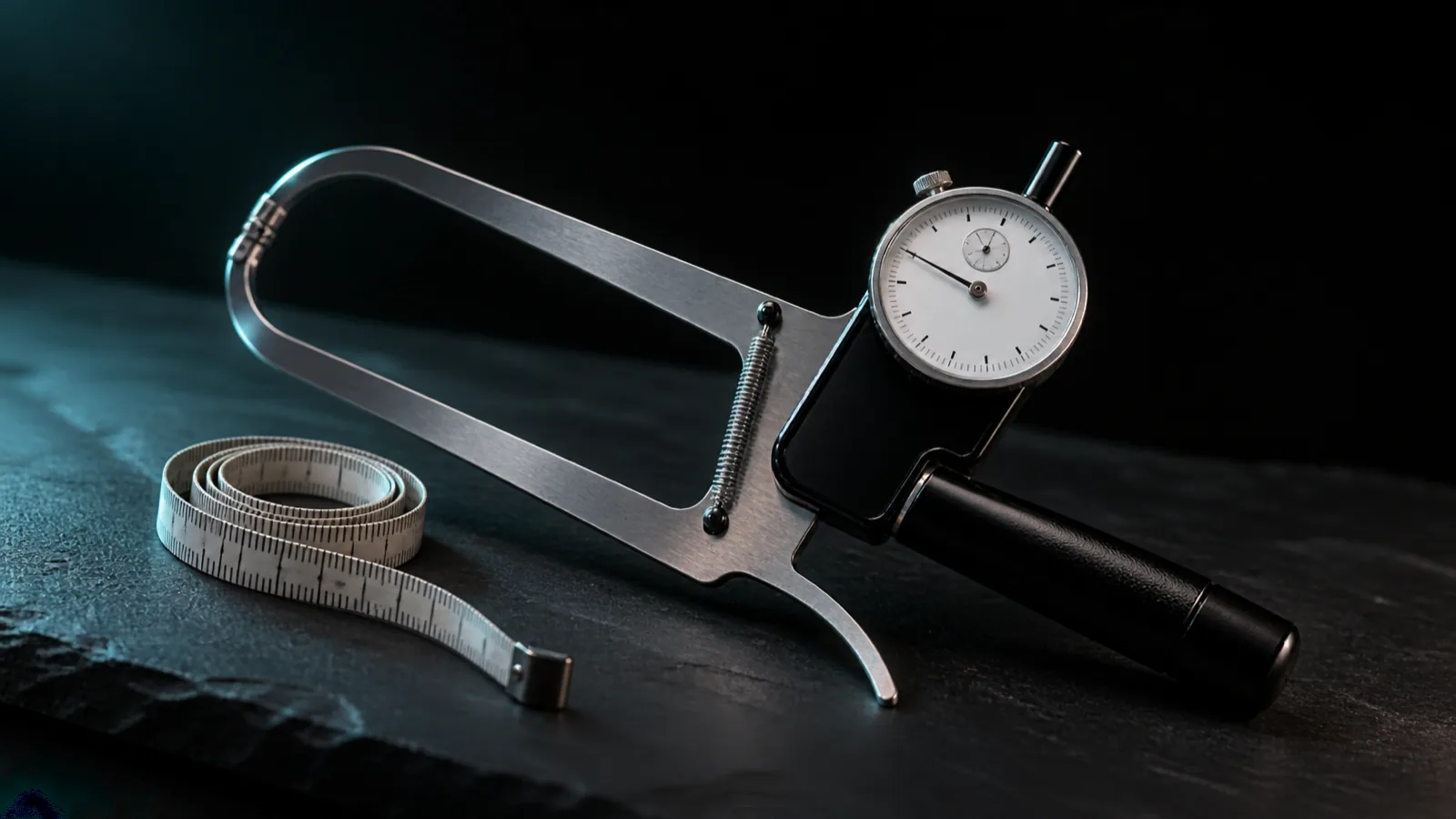
Every way of measuring body fat carries an error bar. DEXA, InBody, calipers and the tape each read the same body differently, and each repeats itself imperfectly. None of that is a reason to bin any of them. It is the reason to read each one inside its error band, and to use each for what it is actually good at.
The error bands matter because of a mismatch in cadence. Cutting and bulking decisions are weekly, sometimes daily; the most accurate measurement most lifters can get is quarterly. Precision is whether two readings of an unchanged body agree. Accuracy is how far a reading sits from the truth. Every method trades one against the other, and the published numbers decide which job each method can hold. What follows is the error band for each, and the numbers behind how RESISTX tracks body composition: frequent repeatable readings carrying the week-to-week slope, occasional accurate ones setting the level, one trend extracted from the noise.
How accurate are DEXA scans for body fat?
DEXA, written DXA in the papers below, is the most repeatable body-composition tool a lifter can realistically book, and it is not accurate to 1%. The 2023 ISCD Official Positions set the minimum acceptable in vivo precision for a single technologist at 3% for total fat mass, and 2% for total lean mass and percent fat. That is the floor a clinic has to clear, not the ceiling it reaches. The same document says precision has to be measured locally, on patients like you, because it is not a number the machine ships with.
Precision is the easy half. Accuracy needs a criterion better than DEXA, which means a four-compartment model. Measured that way in 27 elite judo athletes, the individual 95% limits of agreement for change in body fat ran from -3.7 to +5.3 percentage points, and -2.6 to +3.7 kg for fat mass. The authors put the worst case individual error at about 9% body fat, 6.3 kg of fat mass and 6.4 kg of fat-free mass. Group means agreed. Individuals did not.
Across the published athlete literature, reported DEXA measurement error runs 0.5 to 2.5% CV for lean mass and 0.8 to 5.0% CV for fat mass. That’s a five-fold spread between labs. Which clinic you book matters as much as which technology you book.
Why do two DEXA scans of the same body disagree?
A DEXA number is scanner noise, positioning, and whatever is inside you that morning. In a methodology review of DEXA in athletes, whole-body estimates differed by about 5% for fat and 3% for lean between a supine and a prone scan. Same person, same day, different answer, depending on how you were laid on the bed.
Biology is the bigger lever. DEXA’s soft-tissue model assumes fat-free mass is a constant 73% water, and measured hydration in humans ranges from 72 to 74.5%. Creatine loading, a carb-up, a water cut and a hard session the day before all shift fluid in and out of lean tissue, so the algorithm reads part of that as a change in the fat and lean split. Nana and colleagues recommend presenting fasted, in a standardised state of hydration, and before any exercise for the day.
Hand the clinic this list and keep it identical every time:
- fasted, first thing, before you train
- same machine, same technologist, same software version
- same time of day
- bladder and bowels emptied
- no creatine started or stopped between two scans you plan to compare
Protocol drift is the most common reason a second scan surprises someone.
What counts as a real change on a DEXA scan?
In 60 Division 1 athletes scanned twice on the same day with repositioning in between, total-body fat mass had to move at least 465 g in men and 316 g in women before it could be called a change. As a percentage, that is 4.1% in men and 1.8% in women. Anything smaller is noise.
The number has a name: least significant change, the smallest difference between two scans that is bigger than the machine’s own error. That figure is the DEXA scan’s margin of error for change, and it isn’t one value. It shifts with sex, body region and tissue type.
Treat the regional columns with suspicion. In the same cohort, right-arm and left-arm fat mass needed a 19.6% and 22.2% swing in men before the change cleared the error, and no arm does that in a mesocycle. If the question is whether an arm is growing, track sets per muscle group and watch the working weights, because the input side of the log has a far better resolution than the printout.
A cut running 0.25 to 0.5 kg a week puts 465 g of fat inside 1 to 2 weeks of progress, so 8 to 12 weeks between scans clears the noise floor with room to spare. Knowing which of those rates you are actually running takes a smoothed line rather than one morning’s reading, which is the case for trend weight vs scale weight. Holding that rate is an intake problem, and the food logger you pick decides whether you get adaptive TDEE for lifters or deeper micronutrient detail. Scan fortnightly and most of what you’re reading is the scanner. One caveat on those figures: they come from same-day repeat scans, so they capture technical error only. Two scans 10 weeks apart carry all of that plus your own biology, which makes 465 g the optimistic floor rather than the realistic one.
The weight trend also feeds your calorie estimate. If intake is logged consistently, the rate of weight change lets an app estimate maintenance from the same period, which is the method behind back-calculated expenditure.
DEXA vs InBody: how far apart are the two numbers?
Expect InBody to read leaner. Under controlled conditions an InBody 770 came in 4.0 percentage points below DXA for body fat percentage, with an SD of 2.8 points and a standard error of estimate of 2.6%. The same study ran the obvious correction: adding a flat 3% to the BIA reading cut the bias to 1.0 points and left the scatter sitting exactly where it was, at 2.8. Bias is fixable. Scatter is not.
A 2026 validation in 148 healthy adults on an InBody 970S put the limits of agreement against DXA at +7.74% to -2.67%, a span of 10.41 points. What multi-frequency BIA does have is repeatability, with within-day test-retest reliability for percent fat at an ICC of 0.998 or better. Repeatable and biased at the same time. Precision and accuracy are separate properties, and BIA is the cleanest demonstration of that in the field.
Change is where it gets awkward. Across an offseason, 29 collegiate American football players were tracked by both methods, and DXA and MF-BIA agreed on the direction of whole-body change while agreeing only moderately on the size of it: concordance of about 0.50 for fat-mass change and 0.49 for fat-free mass change. Compare InBody to InBody. Put an InBody number next to a DEXA number and you are measuring the distance between two instruments.
DEXA vs calipers: do skinfolds underestimate body fat?
Yes, and by more than most lifters expect. Against DEXA, the Jackson-Pollock 7-site equation read 7.22 points lower in men and 8.74 points lower in women, with limits of agreement spanning roughly 17 points: -2.43% to 16.86% in men, 0.02% to 17.45% in women.
Those figures come from 59 adults with diabetes, not lifters. Take the direction as read and hold the exact size loosely until someone runs it on a trained population. The offset is systematic rather than random, which is the part that saves calipers. A number that is consistently 7 points low still moves when you move.
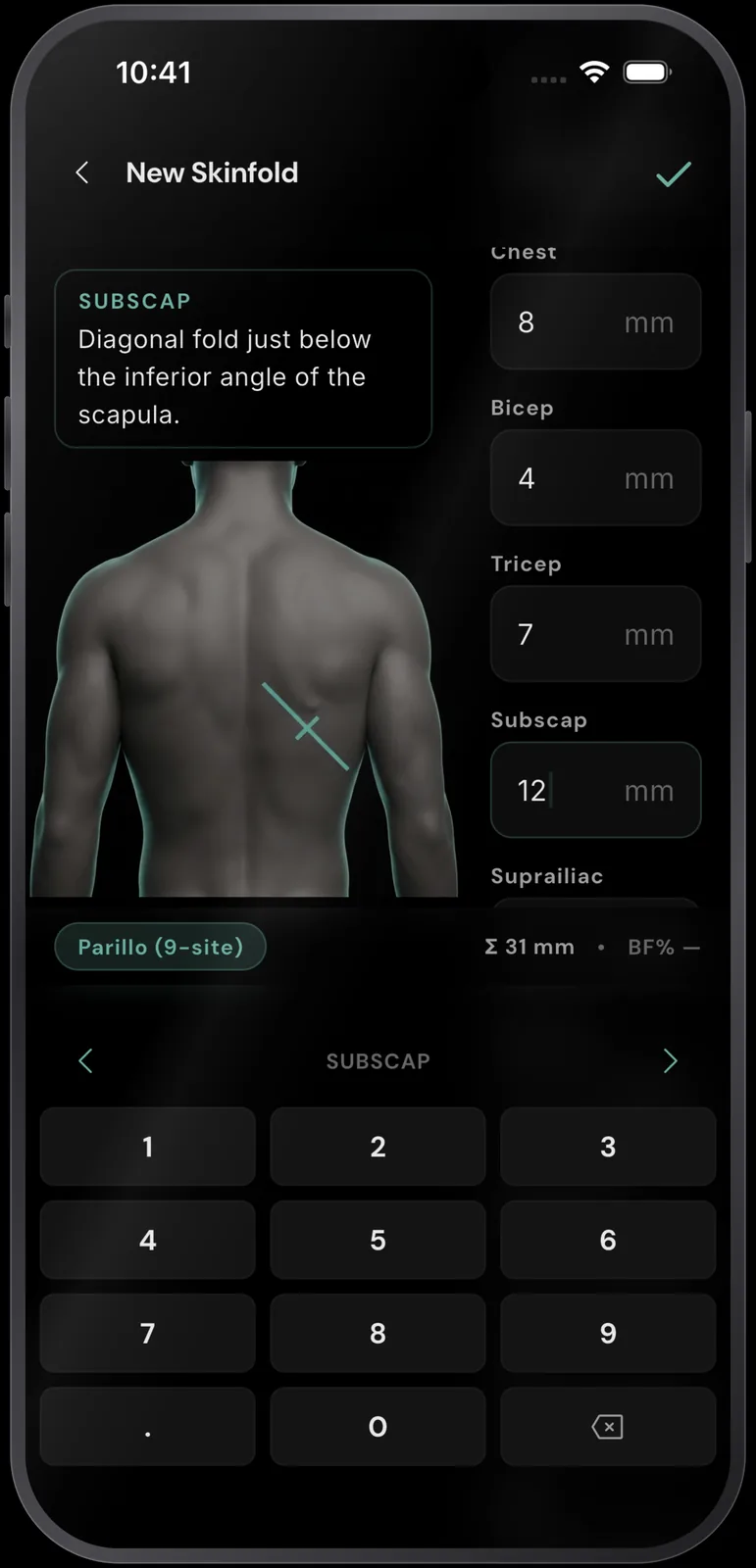
What breaks a caliper trend is the tester: a different pair of hands, a site marked 2 cm off, or a fold pinched in a different order on a different day. Lyle McDonald’s framing holds up here, that tracking relative changes matters far more than true accuracy. Same tester, same sites, same order, every time.
How accurate is the Navy tape test for lifters?
In 609 fit US Marines, the circumference method underestimated body fat in men by 2.6 points with an SD of 3.7, and overestimated it in women by 2.3 points with an SD of 4.3. The cohort was 430 men and 179 women aged 18 to 57, which is about as close to a trained population as the field-method literature gets.
The equation infers fat from neck and waist girth, plus hips for women, scaled to height. Anything that thickens a neck for reasons other than fat, trained traps and a heavier bulk included, pushes the estimate down. That is the structural reason the tape flatters a muscular lifter.
The same paper produced a result the ranking gets backwards. BIA agreed with DEXA more closely than the tape did in that cohort: 0.4 points with an SD of 3.2 in men aged 30 and under, and 1.4 with an SD of 3.1 in women. Use the tape weekly at home on a fixed protocol if you like the trend line. Do not put its number next to a scan and read the difference as progress.
Which method should a self-coached lifter use?
Pick by error band, not by prestige: whichever method’s error is smaller than the change you are trying to detect. In practice that is DEXA every 8 to 12 weeks for a calibrated absolute number, and one cheap method at high frequency for the slope in between.
| Method | Bias vs DEXA | Spread | What drives the error | Cadence | Source |
|---|---|---|---|---|---|
| DEXA | reference | 465 g men, 316 g women to call a total-body fat change real | positioning, food and fluid, machine and software version | every 8 to 12 weeks | Buehring 2013 |
| MF-BIA, InBody | -4.0 points, SD 2.8 | 10.41-point span between limits of agreement | hydration, food, training before the reading | weekly, same time and state | Frontiers in Nutrition 2024, Frontiers in Analytical Science 2026 |
| 7-site skinfolds | -7.22 points men, -8.74 women | about 17-point limits of agreement | tester, site marking, fold consistency | fortnightly, same tester | PLoS ONE 2020 |
| Navy tape | -2.6 points men, +2.3 women | SD 3.7 men, SD 4.3 women | tape placement, neck and waist girth | weekly | Frontiers in Physiology 2022 |
Most tracking gets wrecked by mixing them: a DEXA in July, an InBody in August, and a 4-point drop that is only two instruments disagreeing.
Don’t pick one method and bin the rest. Keep all four, weight them by reliability, and let the occasional scan set the level while the weekly methods carry the slope. That is what body-fat fusion in RESISTX does: DEXA, skinfold and BIA estimates combined and weighted by method reliability, with DEXA scans calibrating the cheaper methods. The scan arrives as the clinic’s PDF, with regional lean and fat, any historical scans embedded in the file, and traceability back to the page each number was read from.
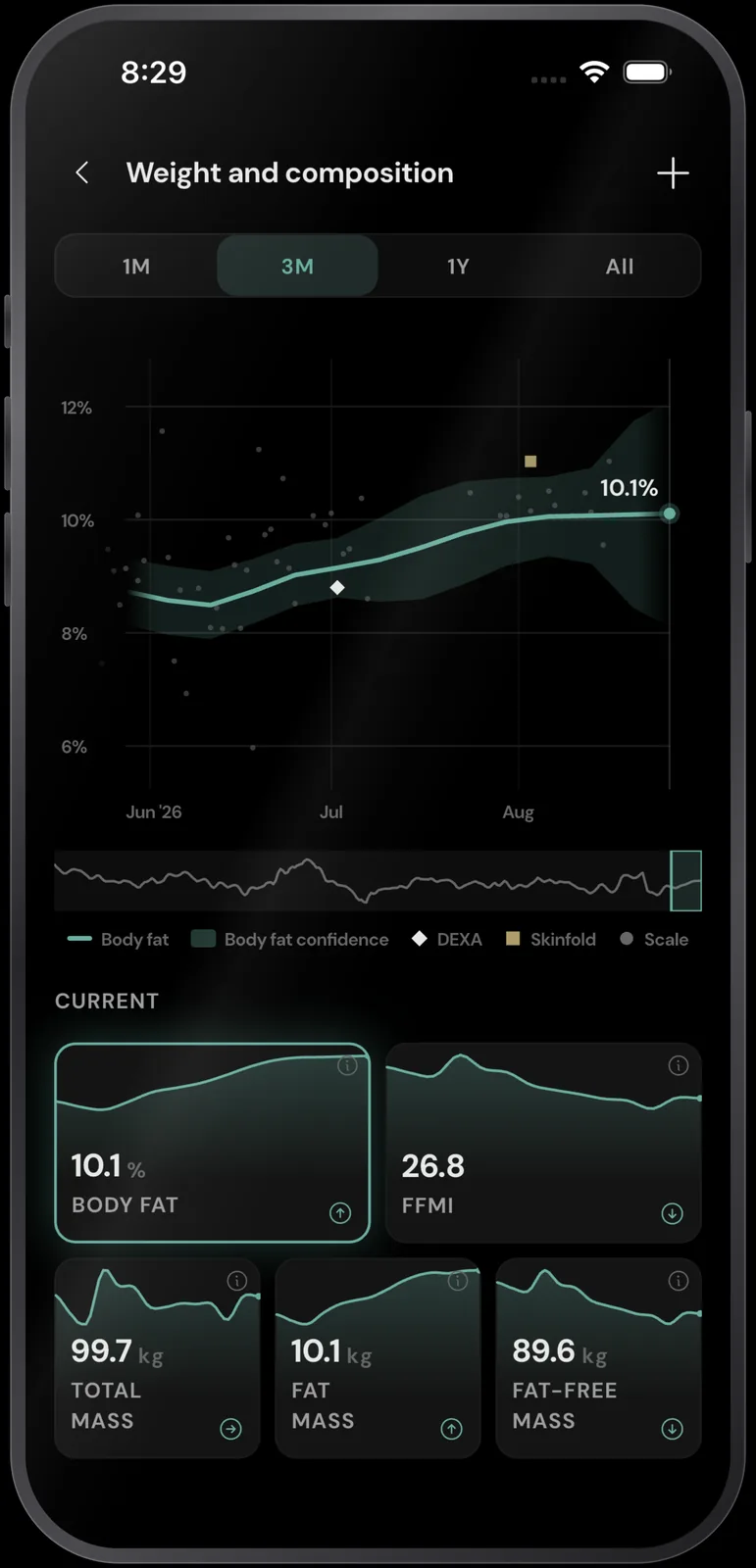
RESISTX is not a coach. It holds the numbers and shows the trend with its uncertainty attached, so what you change in response stays yours. If the trend is flat and the food is where you said it would be, the next input to check is where the week’s sets sit against MEV, MAV and MRV. Most training logs never run that sum, which is the whole of Hevy vs Strong for hypertrophy: both record the set, neither scores the week against those landmarks.
Book the next scan on the same machine, at the same time of day, fasted and before you train, and take your skinfold or BIA reading the same morning. One scan and one cheap reading in the same state is what makes the cheap one worth reading for the 8 weeks after it.
Questions people ask
How often should I get a DEXA scan?
Every 8 to 12 weeks through a cut or a bulk. Least significant change for total-body fat mass was 465 g in men and 316 g in women on same-day repeat scans, and scan-to-scan error over weeks is larger than that. At 0.25 to 0.5 kg of fat a week, 8 weeks puts the expected change well clear of the error band. Scanning monthly mostly measures the scanner.
Why is my InBody number so different from my DEXA?
They are different scales. Multi-frequency BIA carried a bias of 4.0 percentage points below DXA in a controlled study, and a 10.41-point span between limits of agreement in 148 adults. Neither device is broken. Compare InBody to InBody and DEXA to DEXA, and never read the gap between the two as a change in your body.
Are DEXA scans accurate for very lean or very muscular people?
Less than the marketing implies. DEXA assumes fat-free mass is 73% water, so creatine loading, carb-ups and water manipulation all bias the fat and lean split. In elite athletes measured against a four-compartment criterion, individual limits of agreement for change in body fat ran -3.7 to +5.3 percentage points. Keep the protocol identical and read the trend rather than one scan.
Do skinfold calipers underestimate body fat?
Systematically, yes. The Jackson-Pollock 7-site equation read 7.22 points below DEXA in men and 8.74 points below in women, with a limits-of-agreement span near 17 points, in 59 adults with diabetes rather than lifters. The offset is stable enough that one tester repeating the same sites in the same order tracks direction well.